 Tap to zoom
What Is Cryptorchidism or Undescended Testicle?
Learn what cryptorchidism or undescended testicle means, why early pediatric urology evaluation matters, and how orchiopexy and follow-up are handled.
- Published on
- June 26, 2026
- Reading time
- 5 min read
- Last updated
- Updated: June 26, 2026
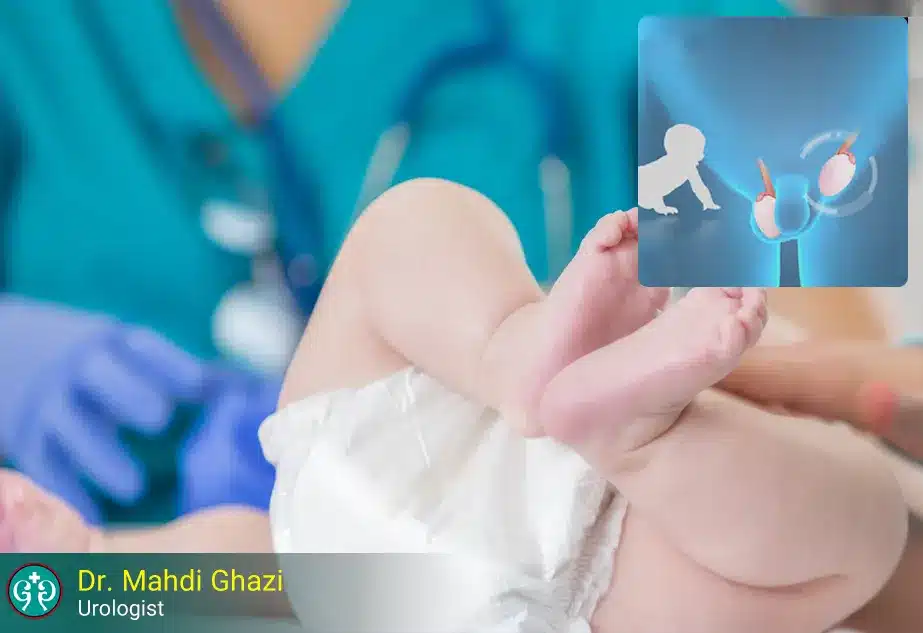
“undescended testicle” is the term used when one or both testicles fail to descend into the scrotum. Your child’s pediatrician evaluates this process (whether the newborn’s testicles have descended or not) during a routine physical examination. In cryptorchidism, the scrotum looks empty and also feels empty on palpation.
Testicles that do not descend into the scrotum will not function normally; the testicles are located in the scrotum so they remain at a temperature lower than body temperature and sperm stay healthy. When the testicles are in the abdomen, they are warmer than they should be. If the testicles remain at a higher temperature for a long time, sperm will not mature properly, and this can lead to infertility. This risk is higher when both testicles remain inside the abdomen. Most of the time, there are no other symptoms for diagnosing this disorder except an empty scrotum.
Epidemiology of cryptorchidism
About 3 or 4 of every 100 male newborns have this defect (21 of every 100 premature newborns).
Of every 100 newborns with undescended testicles, only 10 have the problem on both sides.
How does the male reproductive system form?
The male reproductive system includes the penis, the testicles, and the scrotum. These organs help produce, store, and transport sperm.
Sperm is a very small male reproductive cell. A sperm cell is needed to fertilize the female egg and start the formation of a baby.
The penis includes the glans (head), corona (the ridge between the head and shaft), and shaft (the long part of the penis). The urethral opening is at its tip. The testicles are two organs located in a skin sac (the scrotum) below the penis. These organs produce sperm and testosterone (the male sex hormone).
The scrotum is designed to keep the testicles cool and away from the body. This is because sperm cannot develop at body temperature. Sperm begins to develop in the testicles and matures, gaining motility, as it passes through the epididymis. Normal testicles form early in the development of a male baby while he is still in the mother’s womb. These organs form in the lower abdomen and descend into the scrotum near the end of pregnancy.
Normal testicles attach themselves to stretchable tissue at the bottom of the scrotum. This process is controlled by the child’s natural hormones.
Undescended testicles are associated with higher risks
Testicular cancer in adulthood
Testicular torsion: twisting of the blood vessels that carry blood to and from the testicle.
Inguinal hernia
In about half of boys born with this condition, the testicle descends into the scrotum on its own. This most often happens during the first 3-6 months of life. If the testicles have not descended after 6 months, the child should see a pediatric urologist and treatment may be needed.
Note
This condition is different from retractile testicles. In retractile testicles, the testicles are in the scrotum but may move toward the groin. They can be pulled upward by a normal reflex to cold or fear, or by contraction of the abdominal muscles, but they can also be brought back by hand from the groin into the scrotum. A pediatric urologist can tell the difference with a physical examination.
Ascending testicle
If cryptorchidism appears in older children, it is called an ascending testicle. This happens because the testicle has not attached to the scrotum. Parents usually notice this condition as the child grows.
In these patients, the testicles descend normally at birth but later ascend during childhood. One in every 5 cases is seen in older boys. These testicles need surgery to fix them in the scrotum, because if the testicle remains high, sperm may not mature.
Only testicles that are truly undescended need treatment. To make sure the reproductive system is healthy, boys should be examined during their annual checkup.
Causes of cryptorchidism (undescended testicle)
It is not clear why testicles fail to descend. It may be because the baby was born early and the testicles had not fully developed. Or the testicles may descend but not enter the scrotum. They may instead lie beside the scrotum (ectopic testicles). Or the child’s hormones may not stimulate the testicles as they should to descend into the scrotum.
No study has shown that this condition is caused by something the mother was exposed to or ate during pregnancy.
Some studies suggest that genetics may play a role and that it may be passed down from a paternal relative.
Diagnosis of cryptorchidism
An examination by a pediatrician or pediatric urologist confirms that one or both testicles are not in the scrotum.
The doctor may or may not be able to feel the testicle in the abdominal wall. A testicle that cannot be felt on examination is called “nonpalpable.” Nonpalpable testicles may be in the abdomen (undescended), very small (atrophic), or absent altogether.
Note
It is important to determine whether a testicle is present but has not descended.
An undescended testicle inside the abdomen can develop a tumor later in life. Such a tumor may not be noticed until it becomes large or causes symptoms. Although ultrasound can sometimes show whether testicles are present, it is not a complete test. Because it is not complete, it should not be used to look for an undescended testicle before the child has been seen and examined by a pediatric urologist.
Treatment of cryptorchidism
If your baby’s testicle has not reached its proper place by 6 months of age, you should take your child to a specialist; a pediatric urologist can discuss surgery with you. When testicles do not descend naturally, surgery is needed. In studies, medicines and hormone treatments have not been found helpful for improving this condition.
Surgery to move the testicles into the scrotum is called orchiopexy.
The timing of surgery depends on the following:
Your child’s age
Your child’s general health
Your child’s medical history
Your child’s ability to tolerate anesthesia and surgery
Your comfort level and treatment goals
Orchiopexy surgery
In 98 percent of cases, this surgery is very successful. It involves a small incision in the groin area to locate the testicle. Another small incision is made near the scrotum so the testicle can be placed in the correct position.
This surgery usually takes 45 minutes. In some cases, depending on the location of the testicle, an incision in the scrotal area may be needed.
To begin, the child is given general anesthesia. Almost always, the child can go home the same day as the operation. Normal activities can be resumed within 1 to 2 days after surgery. Pediatric urologists are skilled in laparoscopic surgery.
Laparoscopy
Laparoscopy is surgery performed through a small abdominal incision using a camera and special small instruments to work inside your child’s body. This surgery is done when the doctor cannot feel the testicles and needs to look for them in the abdominal area.
With laparoscopy, an incision is made in the abdomen. In most cases, no scar will be visible later. The testicle(s) found in the abdomen are freed from nearby tissue. They can then be moved into the scrotum. There, the testicle is sutured in place. If a hernia is present (a bulge of an organ or tissue through an abnormal opening), it is repaired at the same time.
In some cases, the testicle is too high for this simple surgery. Other techniques, and sometimes even two operations, may be needed to bring the testicle fully into the scrotum.
Considerations after treatment for cryptorchidism
After treatment, most children grow normally and in good health. They can be fertile like other healthy men. The testicle often grows to a regular size in the scrotum. However, if the testicle was not normal at the start, it may never grow properly. In other cases, sperm will not develop in a testicle that cannot mature in the scrotum.
When the patient reaches adolescence, routine physical examinations should be performed. The patient should also learn to do a monthly testicular self-examination. This preventive care is used to check for signs of testicular cancer. Although the risk of testicular cancer is small, monthly self-exams are important.
Questions to ask your doctor
Should I wait before treating my baby?
Does surgery have side effects?
How long will recovery take?
What should be done after surgery to care for my child?
Will my child have future problems if treated now?
Can he be fertile and have children of his own?
Can we do anything now to reduce my baby’s future risk of testicular cancer?
Actions & related links
Related articles
All articlesWhat Is Polycystic Kidney Disease? (Fetal and Adult PKD)
What is polycystic kidney disease? Learn about inherited ADPKD and ARPKD, fetal and adult symptoms, complications, diagnosis, medicines, surgery, diet, fluids, and prevention-focused care.
What Is a Renal Cortical Cyst? Symptoms, Diagnosis, and Treatment
Renal cortical cyst | Simple vs. complex kidney cysts | Warning symptoms | Diagnosis and treatment | Needle drainage, laparoscopy, medication, and ablation
Kidney Transplant: Cost, Blood Type Compatibility, and Surgical Method
What is kidney transplant? Learn about cost considerations, operation duration and method, diet, who may not be eligible, success rates, isolation precautions, and post-transplant care.
What Is Pyelonephritis? Kidney Infection Symptoms, Diagnosis, and Treatment
What is pyelonephritis? Learn kidney infection symptoms in women, children, men, and pregnancy; diagnosis, antibiotics, treatment, emergency warning signs, and cystitis differences.
Comments
0 comments
No comments yet. Be the first to share your thoughts.