 Tap to zoom
Who Is Laser Treatment for Bladder Prolapse Suitable For?
Who is laser treatment for bladder prolapse suitable for? Benefits and limitations, comparison with surgery, treatment process, number of sessions, cost factors, and aftercare.
- Published on
- June 26, 2026
- Reading time
- 5 min read
- Last updated
- Updated: June 26, 2026
Laser Treatment for Bladder Prolapse: Benefits and Degree of Effectiveness
Laser treatment for bladder prolapse is a modern, low-complication option for women who, in “early to mild stages”, have problems such as urinary incontinence, a feeling of pressure in the pelvic area, or discomfort during marital relations, while not wanting major surgery.
This method is performed in several short sessions without anesthesia or surgical incision and helps patients return to daily life very quickly.
Urologist Bladder disease specialist
Note: To improve care quality and patient satisfaction, appointments are triaged by reason for visit. Each physician sees patients within the relevant urology subspecialty.
Book appointment
Below, you will become fully familiar with the treatment steps for bladder prolapse with laser, its advantages and disadvantages, costs, and aftercare. If you or someone close to you is facing this problem, we suggest staying with us to the end.
Laser Treatment for Bladder Prolapse and Nonsurgical Methods
Laser treatment for bladder prolapse is a minimally invasive and simple method. It is usually suggested for women who are in the early or mild stages of this problem but do not want to undergo major surgery.
In laser therapy there is no incision or anesthesia, and each session lasts only a few minutes. But you should know one important point: laser does not completely treat bladder prolapse.
Appointments related to Urologist Bladder disease specialist
Public recorded-slot data is available for this destination.
Book appointment
What laser does is create controlled heating of the tissue inside the vagina, causing more collagen production and making the tissues firmer and stronger. These changes can improve symptoms of bladder prolapse to some extent in mild cases.
So it is better not to expect the bladder to return completely to its previous position after this procedure; that is usually possible only with specialized surgery.
The effect of laser is not permanent and may need to be repeated after some time. For better results, urology physicians usually recommend laser together with pelvic floor exercises, lifestyle correction, physiotherapy, or weight reduction.
Next, we review in more detail exactly what bladder prolapse is, why it happens, in which cases laser can help, what disadvantages this method has, and how its steps are performed.
Q&A — Urologist Bladder disease specialist
General questions are shown on the destination page after review.
Book appointment
What Is Bladder Prolapse and What Symptoms Does It Have?
Bladder prolapse, or cystocele, is one type of pelvic organ prolapse. This condition occurs when the muscles and supporting tissues of the pelvic floor become weak. As a result, the bladder descends from its normal position and presses against the front wall of the vagina.
Bladder prolapse can have different degrees of severity. In some cases it is mild and causes no symptoms.
But in advanced stages, the bladder may descend so far that part of it protrudes from the vaginal opening and causes bothersome symptoms such as pelvic pressure or urinary problems.
Common Symptoms of Bladder Prolapse
When the bladder descends from its normal position, it can disturb normal urinary tract function and also affect daily activities.
The severity and type of symptoms vary from person to person and depend on the degree of bladder prolapse. If the prolapse is mild, there is usually only a feeling of pressure or heaviness in the pelvis.
But when bladder prolapse becomes more severe, clearer symptoms such as urinary incontinence or difficulty emptying the bladder appear. In general, common symptoms of bladder prolapse are as follows:
Feeling of pressure or heaviness in the pelvis and vagina;
Seeing or feeling a bulge in the vagina;
Difficulty starting urination or intermittent urine stream;
Feeling that the bladder has not emptied completely;
Stress urinary incontinence during sneezing, coughing, or exercise;
Frequent urination or recurrent urinary tract infections;
Discomfort or pain during sexual intercourse.
Causes and Contributing Factors of Bladder Prolapse
The most important cause of bladder prolapse is weakening of the pelvic floor muscles and tissues. This weakness is usually caused by repeated pressure or injury to the muscles.
Factors such as pregnancy, vaginal delivery, or hormonal changes after menopause can worsen the severity of bladder prolapse. In addition, some daily habits and chronic problems also play a role in this condition. Below are the most common causes and factors of bladder prolapse:
Pregnancy and vaginal delivery, especially difficult deliveries or those using forceps or vacuum (forceps or vacuum)
Reduced estrogen hormone level after menopause;
Chronic constipation and straining during bowel movements;
Long-lasting cough due to chronic lung diseases;
Increasing age and natural wear of the bladder-supporting tissues;
Repeated lifting of heavy objects;
Overweight or obesity;
Family history of pelvic organ prolapse;
History of previous abdominal and pelvic surgery.
How Is Laser Treatment for Bladder Prolapse Performed?
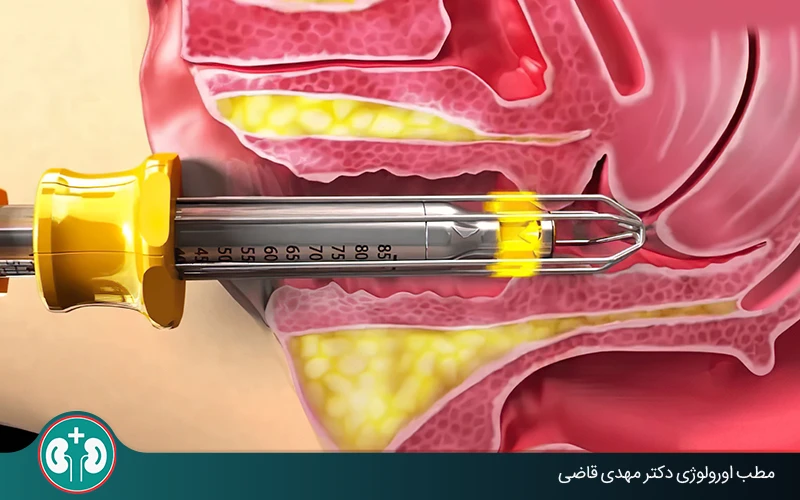
In laser treatment for bladder prolapse, the physician uses laser energy to stimulate the front wall of the vagina with controlled heat so that new collagen is produced and the tissues become firm and strong again. Below, we describe how this procedure is performed:
Steps of Laser Procedure for Bladder Prolapse
1. First, the physician evaluates the degree of prolapse, urinary symptoms, and your childbirth history to determine whether laser is a suitable treatment option.
2. You do not need anesthesia for this method. Usually the specialist uses a small amount of local anesthetic or lidocaine spray at the vaginal entrance so you do not feel pain.
3. Then the urologist gently places the laser probe inside the vagina, and the controlled heat of the laser stimulates the vaginal tissues to increase collagen production. This step takes about 15 to 30 minutes, and its goal is not to change the bladder position, but to reduce mild prolapse symptoms.
4. After the session ends, you can return to daily activities the same day. The only recommendation is to avoid heavy activities and sexual intercourse for a few days.
5. Depending on symptom severity, you may need one to three laser sessions spaced a few weeks apart. However, you should know that there is no defined standard for the number of sessions, and laser effects are usually temporary.
Advantages and Disadvantages of Laser Procedure for Bladder Prolapse
There are still not many studies proving that laser is definitely effective for treating bladder prolapse, but this method can be helpful in mild cases. To complete this discussion, we review the advantages and disadvantages of bladder prolapse laser below:
Advantages of Laser Procedure for Bladder Prolapse
The main advantage of laser is that it is a simple, minimally invasive method to reduce some mild symptoms of bladder prolapse, without needing classic surgery, a surgical incision, or hospital admission. Other expected advantages of this method include:
This method is performed without anesthesia, and usually superficial local anesthesia is enough.
Treatment sessions are short and often take less than 30 minutes.
Recovery time is short, and most people return to normal activities the same day.
Disadvantages of Laser Procedure for Bladder Prolapse
Despite the multiple advantages reviewed above, using laser for bladder prolapse is not always the best choice for every patient. This method has limitations that are important to know before starting treatment:
In severe prolapse, the effect of laser is limited and there is a possibility that traditional surgery will still be needed.
The treatment effect is not the same in everyone, and its results depend on the severity of prolapse and the tissue condition of the person's bladder.
To reach the desired result, several consecutive treatment sessions are usually needed.
The durability of results is not permanent, and booster sessions may be needed after some time.
Scientific evidence about the long-term effectiveness of this method is still limited, and more studies are needed.
This method is usually not covered by insurance, and its cost may be considerable for some people.
Comparison of Laser Therapy and Surgery for Bladder Prolapse
After learning about laser therapy, it is useful to know that alongside minimally invasive methods, different surgical methods such as colporrhaphy, anterior vaginal repair, ligament suspension, laparoscopic surgery, and robotic surgery also exist for treating bladder prolapse.
The urologist usually proposes these methods when the pelvic tissues no longer have enough strength to support the bladder or when the disease reaches advanced stages.
The important point is that if treatment is started in the early stages and pelvic floor exercises, lifestyle correction, and minimally invasive methods such as laser are taken seriously, you will most likely be able to control the disease course and avoid the need for surgery.
The table below compares laser therapy and surgery and shows how much timely treatment affects the difficulty or simplicity of the treatment process.
Row | Laser Therapy | Open Surgery |
|---|---|---|
Suitable for | Mild urinary incontinence | Moderate to severe prolapse or cases where simpler methods have not worked. |
Treatment Area | Surface of the vaginal wall | Bladder-supporting tissues and ligaments |
Treatment Duration | Several short sessions, a few weeks apart | One surgery plus several weeks of recovery |
Onset of Treatment Effect | Gradual improvement over several weeks to several months | Faster improvement; full effect develops over several weeks |
How Much Does Laser Treatment for Bladder Prolapse Cost?
Unlike traditional surgeries, which usually have a defined and fixed cost, the final price of bladder prolapse laser depends on the following factors:
Severity of bladder prolapse;
Type of laser device used;
Number of treatment sessions;
Level of clinic expertise.
Nevertheless, compared with the cost of surgery, laser is usually more cost-effective because the patient does not need hospital admission, anesthesia, or a long recovery period.
Another important point is insurance coverage. Currently, most insurers do not fully cover the cost of bladder prolapse laser because this method is considered a new treatment approach. However, some supplementary insurance plans may cover part of the costs.
Who Is a Suitable Candidate for Laser Treatment of Bladder Prolapse?
Laser treatment for bladder prolapse is not suitable for every patient, and the physician decides whether this method can be the best treatment option based on the severity of prolapse, pelvic floor status, and the person's general health.
In general, the following groups are suitable candidates for this treatment method:
Women who have developed mild bladder prolapse or urinary incontinence after vaginal delivery.
People who prefer to use low-complication, nonsurgical methods to address bladder prolapse.
Women for whom surgery is high-risk or prohibited because of specific medical conditions.
Patients looking for prolapse treatment without anesthesia or hospitalization.
Women who want to combine laser therapy with pelvic floor strengthening exercises, such as physiotherapy or Kegel exercises, for better results.
Ultimately, the specialist physician determines, based on the body's condition and treatment goals, whether laser therapy alone is enough to treat this condition or whether it should be performed together with other methods.
Summary
Laser treatment for bladder prolapse is a low-risk, fast method without the need for major surgery and may be effective for mild bladder prolapse.
This method is performed with minimal pain, has a very short recovery period, and most patients return to daily activities very quickly.
Overall, laser therapy is not a definitive option for treating this disease, but it can manage symptoms of bladder prolapse in its early stages.
Frequently Asked Questions
Actions & related links
Related articles
All articlesWhat Is Polycystic Kidney Disease? (Fetal and Adult PKD)
What is polycystic kidney disease? Learn about inherited ADPKD and ARPKD, fetal and adult symptoms, complications, diagnosis, medicines, surgery, diet, fluids, and prevention-focused care.
What Is a Renal Cortical Cyst? Symptoms, Diagnosis, and Treatment
Renal cortical cyst | Simple vs. complex kidney cysts | Warning symptoms | Diagnosis and treatment | Needle drainage, laparoscopy, medication, and ablation
Kidney Transplant: Cost, Blood Type Compatibility, and Surgical Method
What is kidney transplant? Learn about cost considerations, operation duration and method, diet, who may not be eligible, success rates, isolation precautions, and post-transplant care.
What Is Pyelonephritis? Kidney Infection Symptoms, Diagnosis, and Treatment
What is pyelonephritis? Learn kidney infection symptoms in women, children, men, and pregnancy; diagnosis, antibiotics, treatment, emergency warning signs, and cystitis differences.
Comments
0 comments
No comments yet. Be the first to share your thoughts.